In LING 315: Languages of the World, each student picks an endangered language to focus on. Over the course of the semester, they use a grammar of their language to explore different typological phenomena, such as phonetic inventories, morphological processes, syntactic systems, and clause typing. For each phenomenon, students compare and contrast their languages to develop a set of proposed linguistic universals. For a final project, students could work on anything as long as it was related in some way to their language and what we had been learning about during the term. Here are a few of the MANY cool projects from Winter 2025 semester, presented with approval from the authors!
Pite Saami: Variable Word Order Paper Dolls (Eli German)
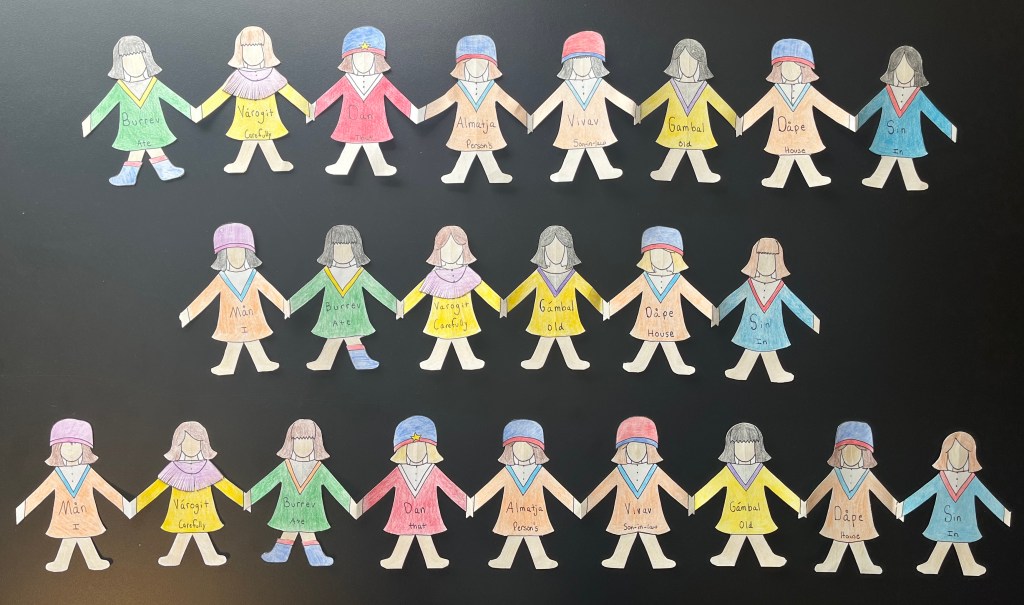
In general, Pite Sami (Uralic) has very loose word order. However, there are some constructions in which word order is strictly defined and many where word order affects the interpretation of the sentence (information structure). Eli collected samples of different word orders in the language and then used paper dolls, wearing traditional Sami clothes, to represent their variability. The color of the coat indicates part of speech, and hats and boots indicate nominal and verbal morphology, respectively.
Kunbarlang Verb Generator (Erin Wyndham)
Kunbarlang is an Australian Aboriginal language with complex verbal morphology. Inspired by online verb generators for other polysynthetic languages, Erin created a verb generator for Kunbarlang. Users can select a verb, a doer, an undergoer, and a tense, and see what the resulting verb form should look like. Click HERE to try it out!

Uralic Consonant Gradation: Patterns and History (Hazel Grover)
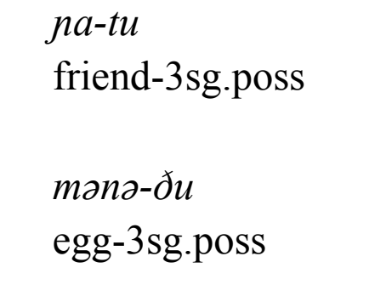
Consonant gradation is a process by which a consonant changes how it is realized depending on properties of the syllable. To better understand this complex process, Hazel compared Nganansan and Finnish, two Uralic languages with slightly different manifestations of consonant gradation, in order to get a better sense of how the phenomenon manifests across the language family. Notably, unlike Finnish, Nganasan has two different processes of gradation: rhythmic and syllabic. An example of Nganasan consonant gradation is shown below; the 3SG.POSS morpheme alternates between /t/ and /ð/ based on mora count (odd vs. even moraed suffix).
Cayu-Go Fish: A Beginner’s Guide to Cayuga Sentence Formation (Grace Kosten)
As a polysynthetic language, words in Cayuga (Iroquoian) often express the same information as a full sentence (subject, verb, object, etc.). This info is marked on verb roots with a complex system of pre-pronominal prefixes denoting subject/object and aspect markers. To help practice making simple sentences in Cayuga, Grace created a card game, based on Go Fish, in which players collects parts of a word to try to make a complete Cayuga sentence. Some example cards are below.

The Sunwar Life: Laughs, Luck and Language (Katelyn Lamoureux)
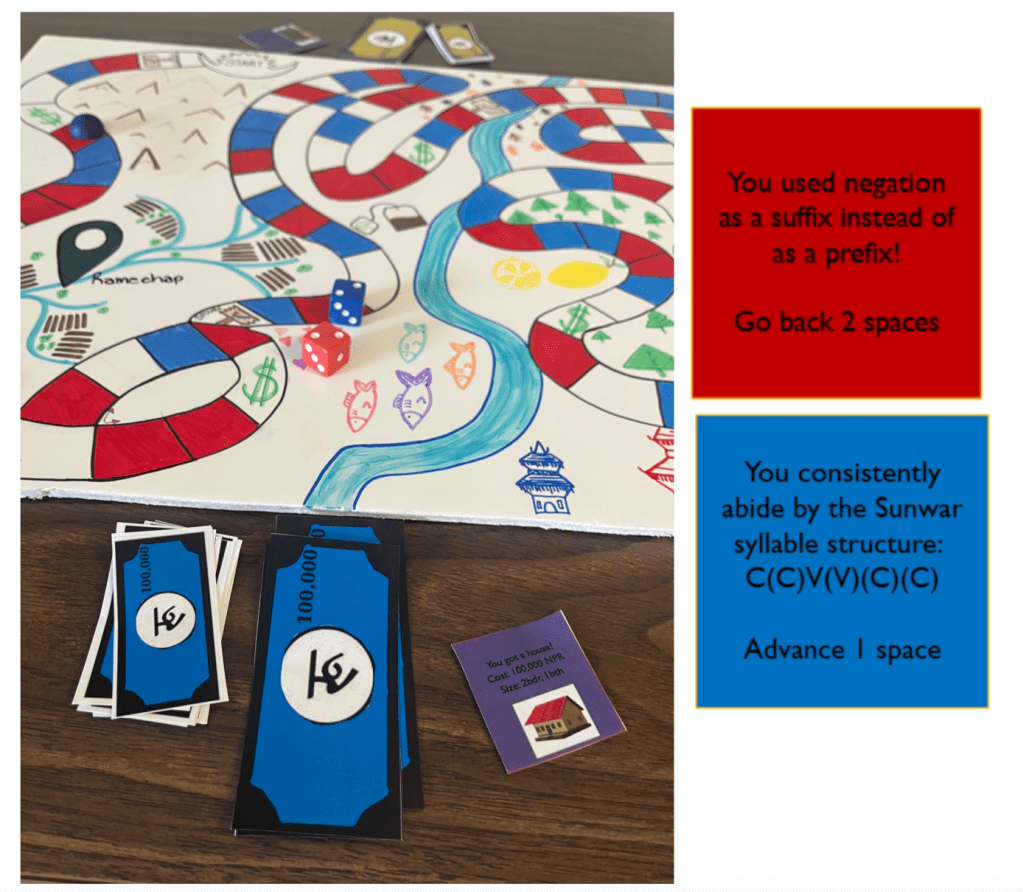
Sunwar (Sino-Tibetan) is spoken primarily along the Likhu Khola river in eastern Nepal. Bringing together linguistic and cultural contexts, Katelyn created a Sunwar version of the popular Game of Life board game. Players progress through life along the Likhu Khola, building a house, raising a family, and speaking the language. Special cards reward or punish players for making grammatical mistakes or successfully picking up on phonological properties of Sunwar, as seen below.
A New Age of Māori: An Analysis of the Online Presence and Revitalization of Māori (Kyle Munns)
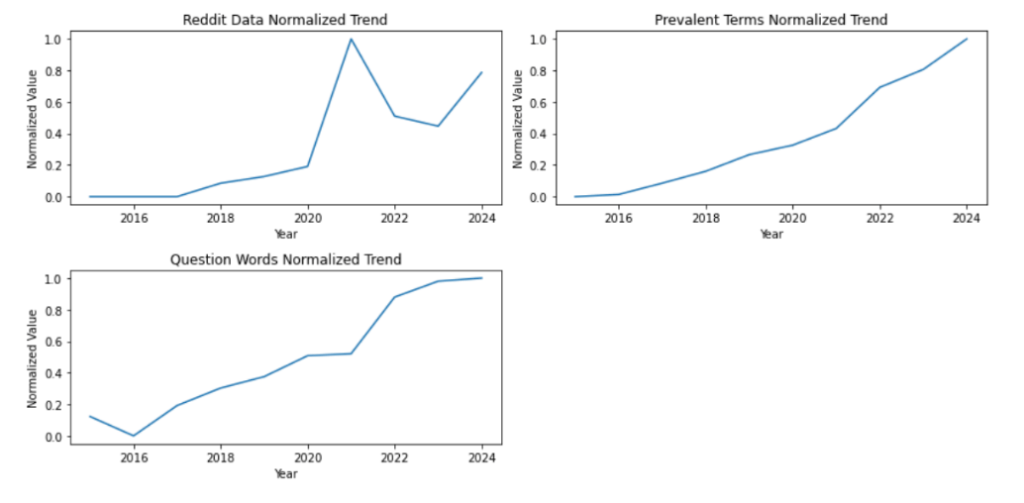
Māori (Austronesian) is relatively unique across endangered languages for the scale of its current revitalization efforts which even has backing from the New Zealand government. To evaluate the effectiveness of the array of different language efforts going on in the country (including language nests, immersion schools, Māori broadcast media, etc.), Kyle undertook a data driven analysis of the presence of the language online, specifically looking at the trajectory of Māori usage on Reddit and Google Trends. He found that searches involving common terms and question words in Māori continue to grow on Google while Reddit activity is generally on the up, albeit with a sharp decline in 2021-2022 (potentially a symptom of general post-COVID dips in online activity).
Small-Scale Multilingualism and the Yukaghir People (Lindsay Hempstead)
Yukaghir (isolate) is spoken in northeastern Siberia in a multilingual region where Even (Tungusic), Yakut (Turkic), Chukchi (Chukotko-Kamchatkan), and Russian are prevalent. Lindsay investigated the history and consequences of this “small-scale multilingualism” with a focus on the socio-cultural factors at play among the different linguistic and ethnic groups. Notably, until the Russian colonial period, the region’s languages were used interchangeably by the different groups, suggesting that reciprocal and egalitarian multilingual environments are in fact beneficial for language preservation.

Where Did Ainu’s “Fourth Person” System Come From? (Zhanpeng Shao)
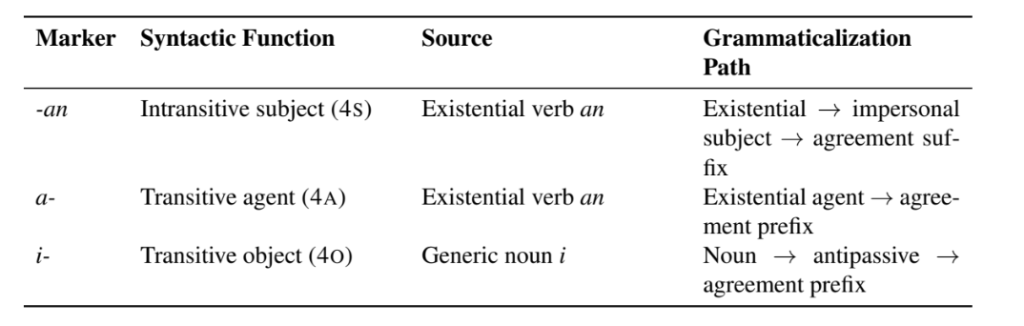
Unlike most languages, Ainu (isolate) has a four-way distinction in its person system. While languages like English distinguish between first (the speaker), second (the listener), and third person when talking about nouns, Ainu also has a fourth person category. Interestingly, Ainu fourth person can be used for four different purposes: (i) first person inclusive (like “on” in French), (ii) honorific second person (like “thou”), logophorif reference (when quoting others), and (iv) indefinite participants (someone). Zhanpeng researched the potential diachronic origins of the form and its various uses, showing that Ainu fourth person likely came from three different sources, as shown below.
 Willie Myers