My past annotation work has been as a member of an ongoing research partnership between McGill University and the Kanien’kehá:ka Onkwawén:na Raotitióhkwa Language and Cultural Center (KORLCC; https://www.korkahnawake.org/) in Kahnawà:ke. Following the partnership agreement, all language data is archived at KORLCC and can only be accessed or shared with approval by the KORLCC board of directors. In other words, these materials are not openly accessible.
Because I cannot share links to my best work, I have put together some examples of annotations from projects on which I worked that have received approval for public access (or for which I’ve received specific consent for sharing in this application). I discussed this option via email with Mandana Seyfeddinipur.
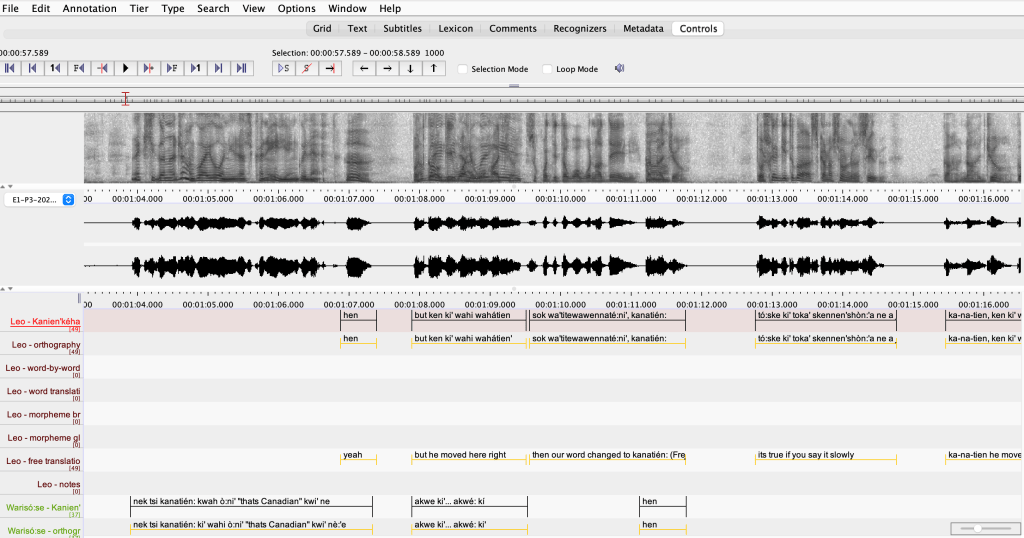
1. Kanien’kéha Radio Transcription Project — In 2023, I acted as project manager of this project in which 15 second-language learners worked together to transcribe and translate past episodes of Kahnawà:ke’s All-Kanien’kéha Radio Show. We used Audacity to edit .wav source files and ELAN to annotate. Here is an example of an ELAN file with transcription and translation data.
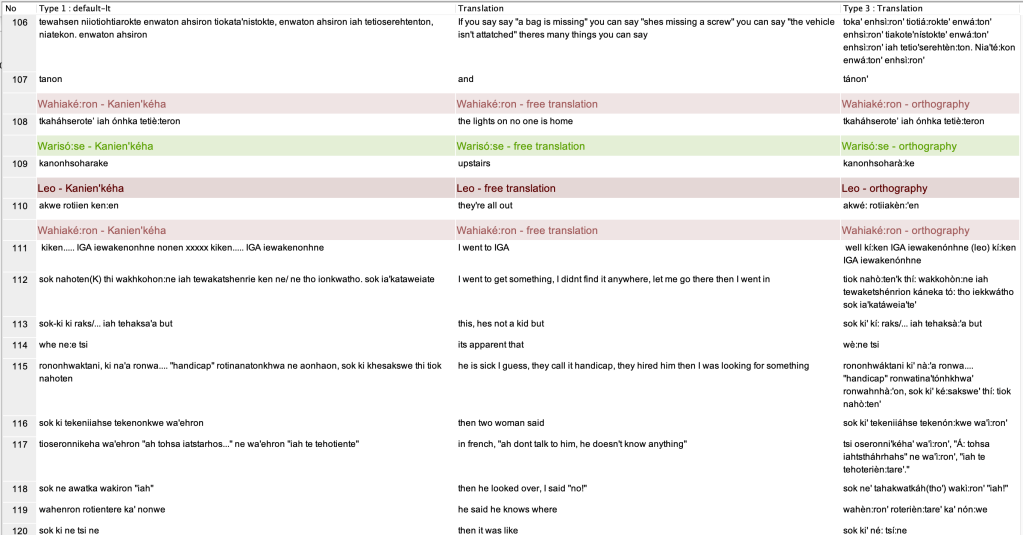
To get a better representation of the outputs, here are links to one section of an episode from the project that was transcribed and translated and then received approval for wider dissemination. This section features a scary story called Ráhskan Oká:ra (“skeleton story”), told by Joe (Só:se) Aniatará:ken McGregor on October 23, 2019. Kanontienentha Brass did the annotation and worked with KORLCC to allow for its sharing on their YouTube channel. The links below give a sense of the transcription and translation done during this project.
- Ráhskan Oká:ra with Kanien’kéha subtitles: https://www.youtube.com/watch?v=x4goKsPYK7E
- Ráhskan Oká:ra with English subtitles: https://www.youtube.com/watch?v=VUaNOEjqRXc
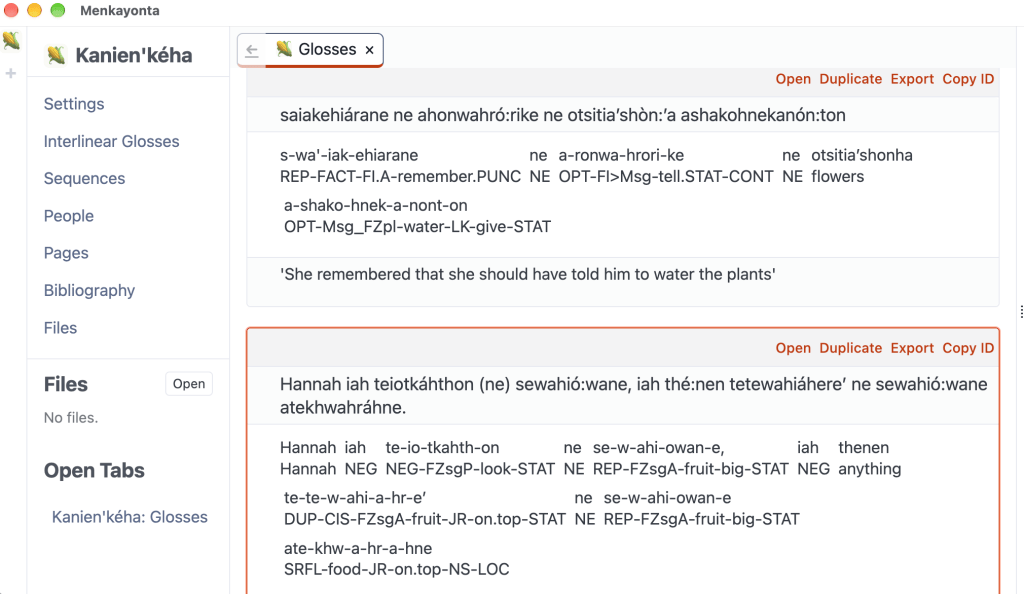
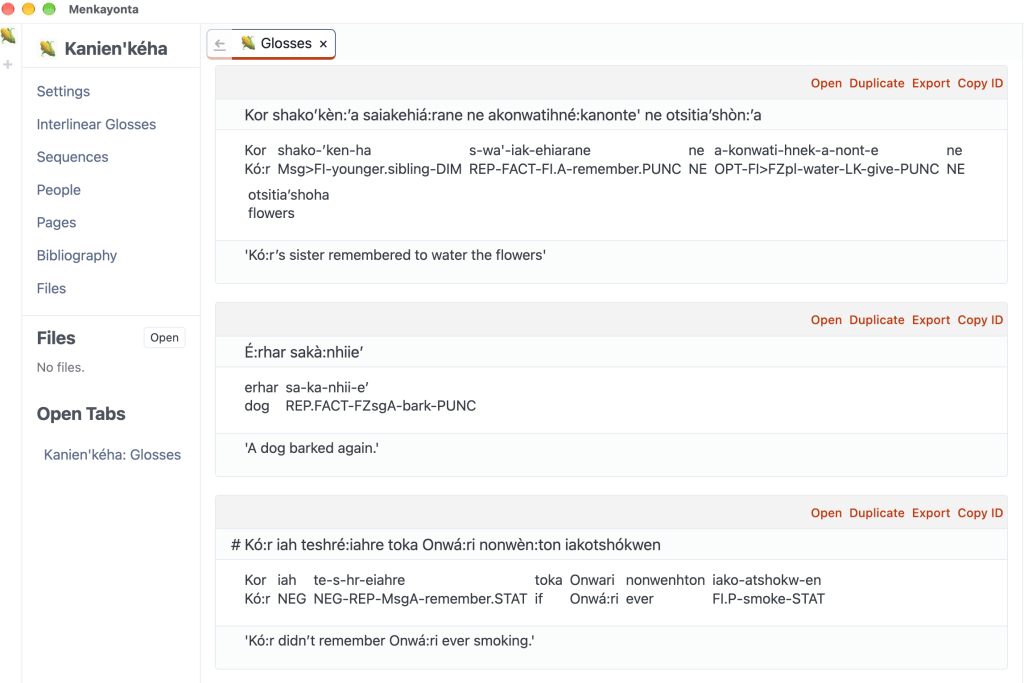
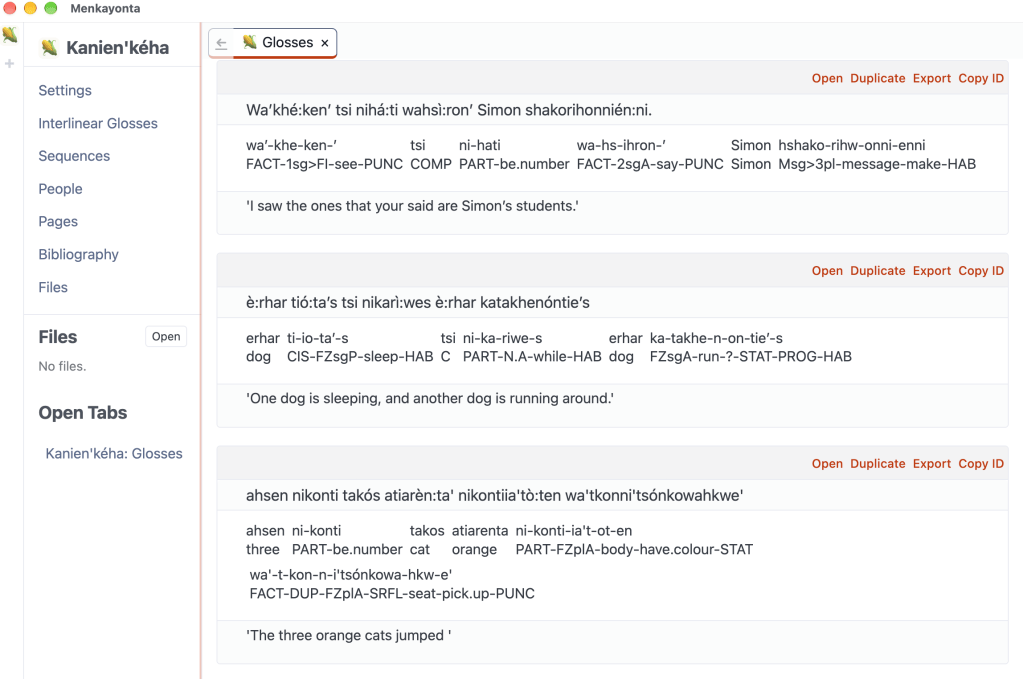
2. Menkayonta — As part of my analytical research on Kanien’kéha, I conduct elicitation sessions with speakers which are recorded and then transcribed. Examples are annotated with morpheme-by-morpheme glosses. This data is collected with the software Menkayonta (https://www.menkayonta.org/) and exports are then sent to KORLCC for archiving. I’ve been storing my annotation data in this archive since 2023. Here are several examples of my morpheme-level annotations for elicited languages examples.
3. LING611 transcription — In fall 2024, I took part in a McGill course called “Structure of a Specific Language” which focused on Kanien’kéha. In this class, one activity was to transcribe part of a story told by speaker Mary Onwá:ri Tekahawáhkwen McDonald. Here is the final result of the transcription, made accessible via LingView, an open access software for presenting language data with recordings. Note: the video works best in Chrome.
LINK: https://kanienkeha-lingview.lingspace.org/#/story/8aa60778-6077-4053-8f18-02b6c87671fc
Users can toggle the Kanien’kéha transcription, English sentence-level translation, word breaks, English word-level translation, morpheme breaks, and morpheme gloss on or off. The video was illustrated by several students in the class.
Please reach out to me if you would like to see more examples!

